
Global DNS Fleet
Managing thousands of authoritative zones across geographically distant servers with high latency requires precise, deterministic system design. Below is the structured technical brief for the global DNS fleet architecture, presented by Mr. Spock.
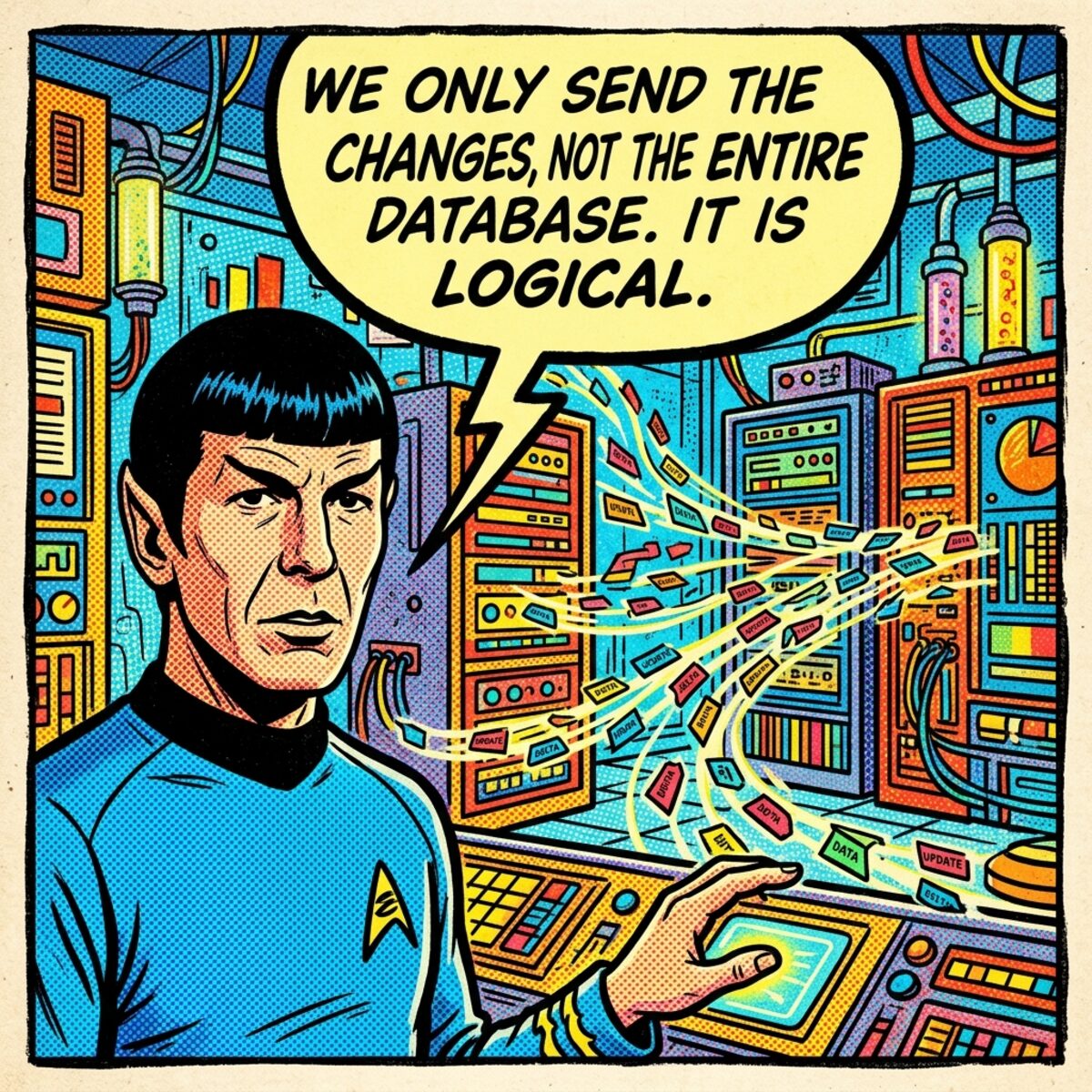
Slide 1: The Transfer Layer — IXFR & NOTIFY (Delta Replication)
“To retransmit entire zone files (AXFR) for minor updates is highly illogical. We must transmit only the deltas (IXFR) triggered immediately by push notifications (NOTIFY).” — Mr. Spock
Technical analysis
At thousands of constantly-changing zones, re-sending entire zone contents on every change is the single largest avoidable cost. We utilize purpose-built, DNS-native replication:
NOTIFY: A low-latency push trigger where the primary node alerts secondaries: “SOA serial changed, fetch updates.”IXFR: Transfers only the delta/diff since the last serial, instead of the whole zone.AXFR: Full zone transfer, retained only as a fallback when a secondary has no prior state or the delta chain is broken.
Example configuration fragment (BIND primary):
zone "example.com" {
    type primary;
    file "/etc/bind/zones/example.com.zone";
    notify yes;
    also-notify { 10.10.1.5; 10.20.1.5; 10.30.1.5; }; // Regional hubs
    allow-transfer { key hub-tsig-key; };
};
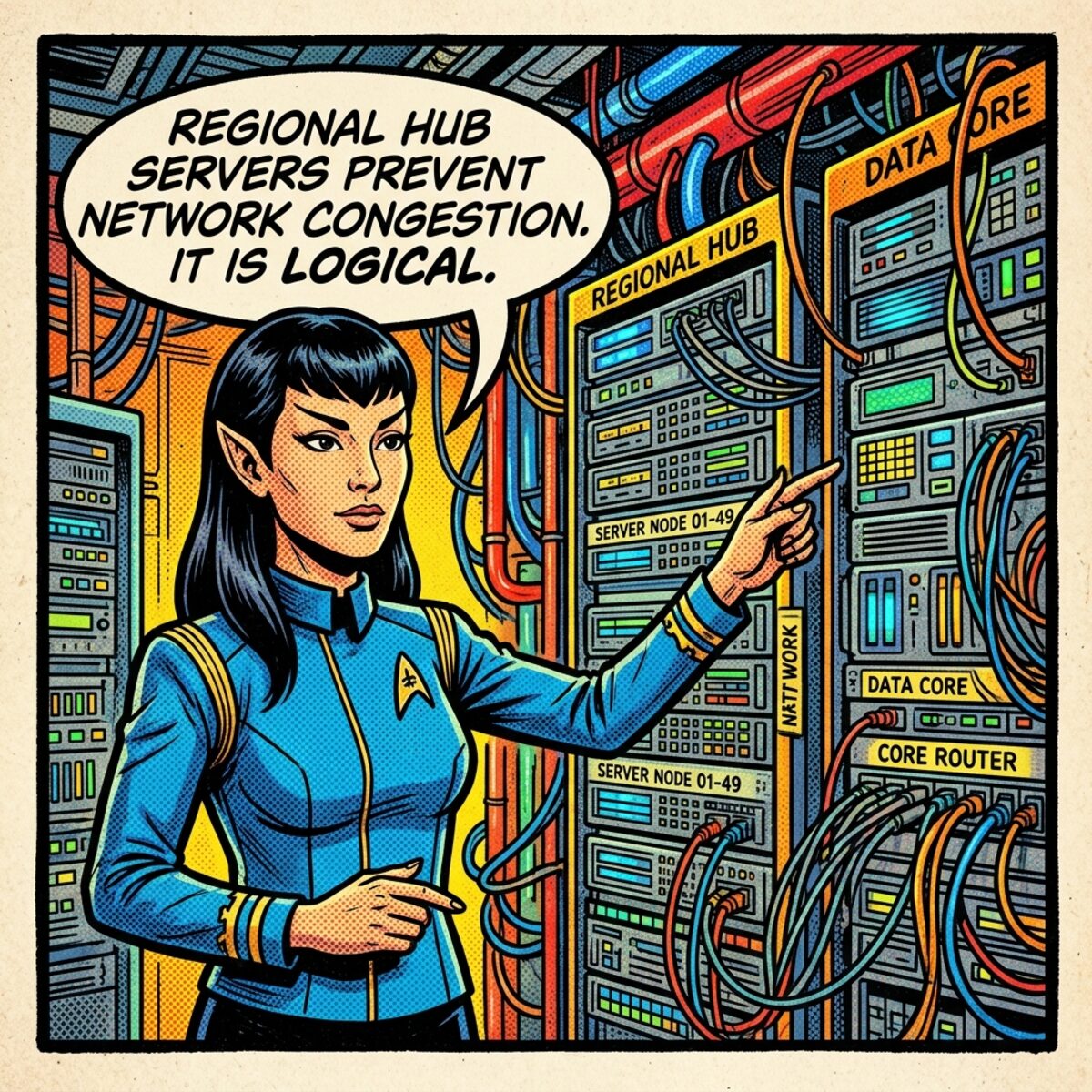
Slide 2: The Network Tier — Tiered Relay Topology
“Regional hubs act as signal relays. Bounding high-latency transit to a single hop is the only logical method to optimize global convergence.” — Mr. Spock
Technical analysis
Direct synchronization between a single primary node and thousands of geographically distant secondary servers is suboptimal; it introduces high propagation delays and excessive CPU overhead on the primary.
                 ┌───────────────┐
                 │ hidden primary │
                 └───────┬───────┘
        ┌────────────────┼────────────────┐
        ▼                ▼                ▼
   regional hub      regional hub     regional hub
   (e.g. EU)          (e.g. US)        (e.g. APAC)
        │                │                │
   ┌────┴────┐      ┌────┴────┐      ┌────┴────┐
   local      local  local      local  local      local
   secondary  secondary ...     ...    ...        ...
- Hop minimization: the long, high-latency hop (primary → distant region) happens once per region, not once per server.
- Intra-datacenter fan-out: hub → local-secondary fan-out is low-latency, high-speed local traffic.
- Load reduction: the primary’s fan-out load drops from “every secondary worldwide” to “one hub per region.”
Slide 3: Fleet Management — Catalog Zones (RFC 9432)
“Orchestrating zone configurations on individual nodes manually introduces unacceptable human variance. Managing configurations as data within catalog zones is a superior operational model.” — Mr. Spock

Technical analysis
At thousands of zones, hand-configuring each secondary’s zone list does not scale.
- Data-plane configuration: RFC 9432 catalog zones declare the full set of member zones inside a special meta-zone.
- Zero configuration overhead: adding or removing a zone across the fleet is done by editing the catalog zone. The change propagates via normal
NOTIFY/IXFRchannels. Secondaries read the catalog and auto-provision/de-provision zones locally without requiring configuration management (e.g., Ansible, Puppet) pushes. - Compatibility: native support is available in modern versions of BIND (9.19+), Knot DNS, and PowerDNS.
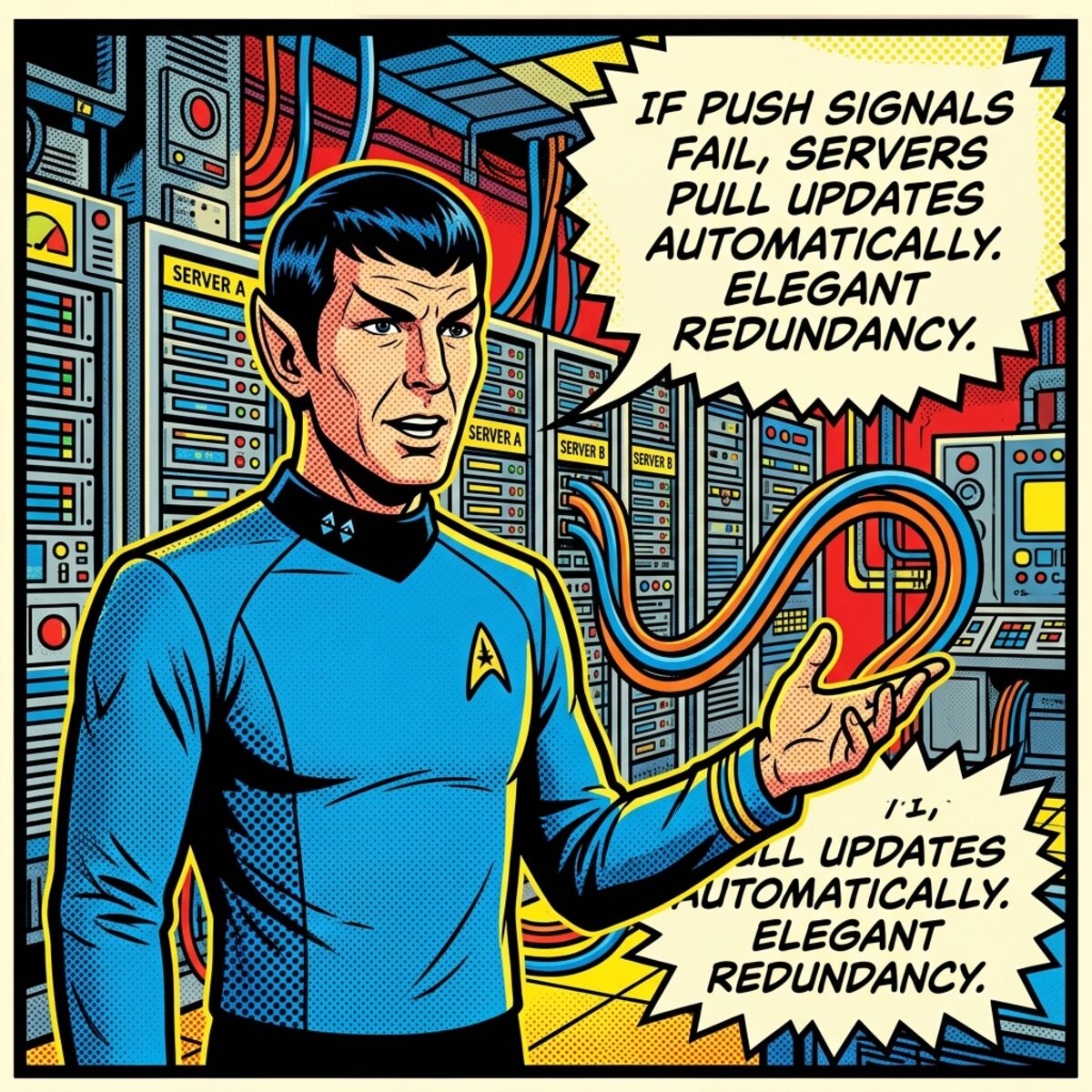
Slide 4: Verification & Fallbacks (SOA REFRESH/RETRY & TSIG)
“System reliability requires a deterministic backstop. If push signals fail due to packet loss, secondaries must pull updates autonomously. Cryptographic validation ensures authenticity.” — Mr. Spock
Technical analysis
Because public long-haul links are prone to packet drops and transient partitions, our design incorporates fail-safe verification and cryptographic authentication.
REFRESH/RETRYbackstop:NOTIFYis a push optimization, not a delivery guarantee. A reasonably shortREFRESHinterval ensures secondaries pull updates on a schedule if notifications fail.- Cryptographic security: we enforce TSIG (or XFR-over-TLS) on all transfers across WAN/public links to guarantee authenticity and prevent unauthorized zone transfers.
Example SOA record with backstop timers:
$TTL 300
@   IN SOA ns1.example.com. hostmaster.example.com. (
        2026071901 ; serial
        300        ; refresh (5 min)
        60         ; retry
        1209600    ; expire
        300 )      ; negative cache TTL
Slide 5: Alternative Protocols & Scale Limits
“Gossip protocols are highly efficient for event propagation but mathematically insufficient as a primary transport for state replication. Should scale increase by orders of magnitude, we must transition to decoupled pub/sub pipeline replication.” — Mr. Spock

Technical analysis
We evaluated gossip/epidemic protocols (e.g., SWIM, Serf) and decoupled storage systems for extreme scale:
Gossip / epidemic protocols (SWIM, Serf)
- Verdict: optional enhancement to the notification layer only.
- Strengths: rapid peer-to-peer event routing around degraded links.
- Limitations: best-effort delivery only (no receipt guarantee). Small payload capacity makes it unable to carry actual zone data. Hence, the transfer must still utilize
IXFR.
Decoupled replication (etcd/Raft or pub/sub pipeline)
- Verdict: reserve for extreme load (many updates per second).
- Mechanism: zone data resides in a replicated distributed store. Local nameservers serve from a fast memory cache synced via pub/sub rather than DNS AXFR/IXFR. Highly complex; only deploy if measured performance shows DNS-native replication is saturated.
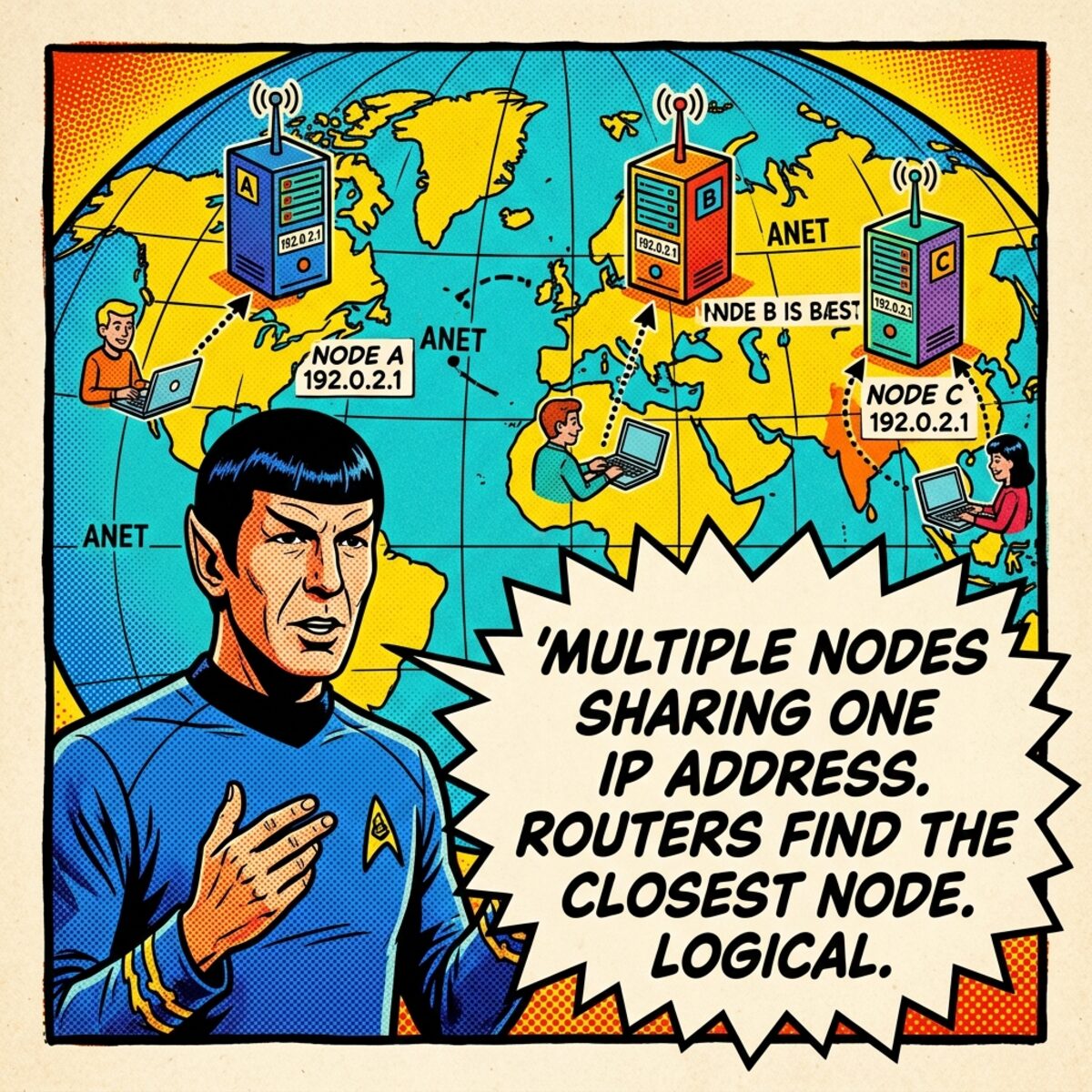
Slide 6: Query-Serving Resilience — Anycast Routing
“Everything discussed thus far governs how zone data reaches a server. It says nothing of how a resolver reaches that server. Announcing the same address from every region and letting the network route to the nearest healthy instance is the only logical answer.” — Mr. Spock
Technical analysis
Slides 1–5 solve data replication: getting correct zone content onto every secondary. They say nothing about query serving: how a resolver on the other side of the planet finds and reaches a healthy, low-latency server. That is a distinct problem, solved at a different layer — the network layer, not the DNS protocol layer.
- Same IP, many sites: each regional hub’s local secondaries (or the hub itself) announce an identical IP address via BGP from every PoP.
- Nearest-instance routing: Internet routing naturally converges each resolver’s query to the topologically closest announcing site — no client-side configuration or geo-DNS trickery required.
- Automatic failover: if a site or upstream link fails, that site withdraws its BGP announcement; traffic reconverges to the next-nearest site within normal routing convergence time, with no dependency on resolver caching or TTLs.
- Blast-radius containment: volumetric attacks (e.g., DDoS) are absorbed locally at the nearest anycast site rather than saturating a single point of presence.
- Orthogonal, not a substitute: anycast changes which physical server answers a query — it does not replace IXFR/NOTIFY, catalog zones, or TSIG. Every anycast node still depends on Slides 1–4 to hold correct, authenticated zone data.
   IP 192.0.2.53 announced from every PoP via BGP

   EU PoP (192.0.2.53) ── advertises route ──┐
   US PoP (192.0.2.53) ── advertises route ──┼── Internet routing table
   APAC PoP (192.0.2.53) ─ advertises route ─┘

   Resolver in Frankfurt  → routed to EU PoP  (fewest hops/lowest cost)
   Resolver in Singapore  → routed to APAC PoP (fewest hops/lowest cost)
Technical summary matrix
| Layer | Mechanism | Purpose |
|---|---|---|
| Data transfer | IXFR | Move only the diff, not the whole zone |
| Push trigger | NOTIFY | Low-latency “something changed” signal |
| Topology | Hidden primary → hubs → secondaries | Bounds propagation delay across long-haul links |
| Zone-list management | Catalog zones (RFC 9432) | Add/remove whole zones without per-server config changes |
| Security | TSIG / XFR-over-TLS | Authenticate transfers across public/long-haul links |
| Correctness backstop | SOA REFRESH/RETRY | Guarantee eventual convergence even if NOTIFY is lost |
| Optional latency boost | Gossip (Serf/SWIM) at hub tier | Route notification around degraded direct links at large hub counts |
| Query serving | Anycast (BGP) | Route resolvers to the nearest healthy instance; automatic failover on site/link loss |
This is the only logical choice to run DNS at global scale. Live long and prosper.